
Resources & Reports
CO2EFFICIENT is a leader in developing transformational 21st century policies — merging environmental sustainability and corporate governance with digital infrastructure and technology solutions.
Explore recent reports, filings, and research-led initiatives
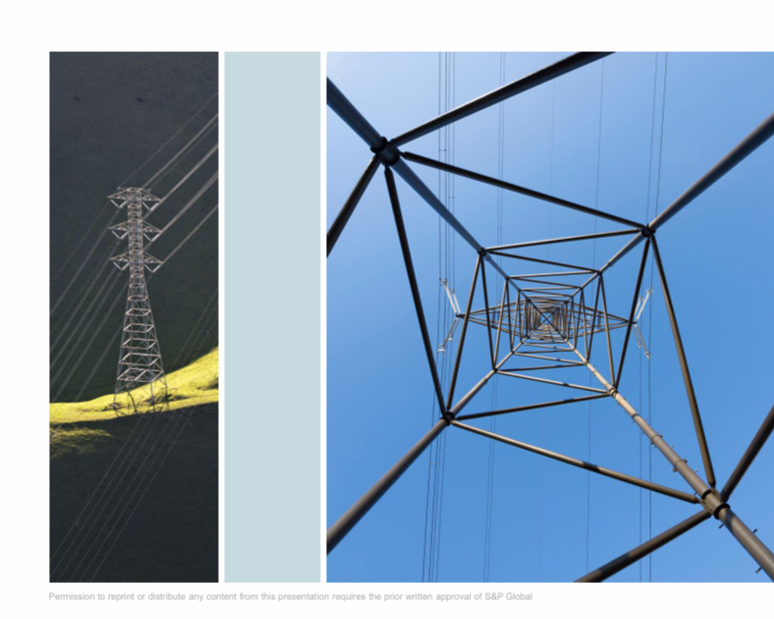
Powering Growth and Affordability: The Role of Transmission in Economic and National Security
Powering Growth and Affordability: The Role of Transmission in Economic and National Security, prepared by S&P Global CERA Consulting for the Electricity Customer Alliance (ECA), National Grid, and Converge Strategies, evaluates four regions across the Eastern Interconnection—the Northeast, PJM, Southwest Power Pool (SPP) and Midcontinent Independent System Operator (MISO) South, and SERC—comparing futures in which transmission expansion is constrained with scenarios that allow greater interregional transmission development.
The analysis finds that transmission delivers more benefits than costs in every scenario studied, generating as much as $15.3 billion in net system value through 2050. Critically for customers, scenarios with expanded interregional transmission deliver two to three times more value than scenarios that rely on more constrained, local solutions.
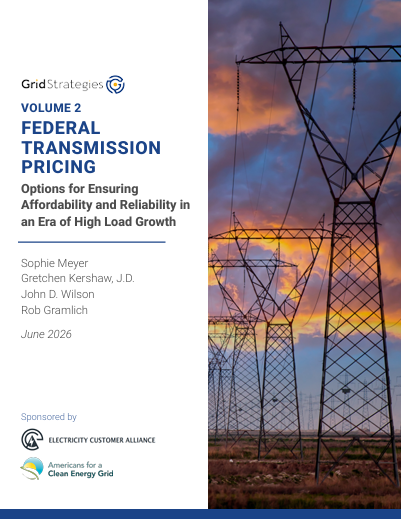
VOLUME 2 Federal Transmission Pricing: Options for Ensuring Affordability and Reliability in an Era of High Load Growth
The Electricity Customer Alliance (ECA), in partnership with Americans for a Clean Energy Grid (ACEG) and Grid Strategies, released “Federal Transmission Pricing Volume 2: Options for Ensuring Affordability and Reliability in an Era of High Load Growth,” a new white paper examining policy options to ensure transmission costs are allocated fairly as electricity demand grows from data centers, advanced manufacturing, and other large customers.
The white paper evaluates a range of transmission pricing, cost allocation, planning, and cost recovery reforms that could help maintain affordability and reliability while ensuring all customers pay their fair share of the costs associated with expanding the electric grid.
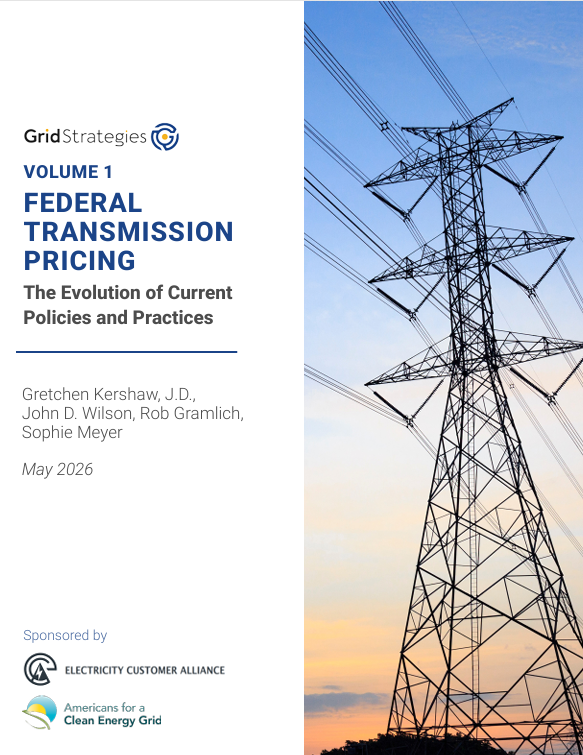
VOLUME 1 Federal Transmission Pricing: The Evolution of Current Policies and Practices
Volume 1 of this two-part report — prepared by Grid Strategies and co-published with Americans for a Clean Energy Grid — is a primer on how federal transmission pricing got to where it is today and why the current framework looks the way it does.
It walks through the Federal Power Act’s division of authority between FERC and the states; the cost causation and beneficiary-pays principles that anchor FERC’s “just and reasonable” standard; the key orders — 888, 2000, 2003, 890, and 1000 — that shaped today’s framework; and how local, regional, and interconnection-related transmission costs are allocated and recovered in practice.
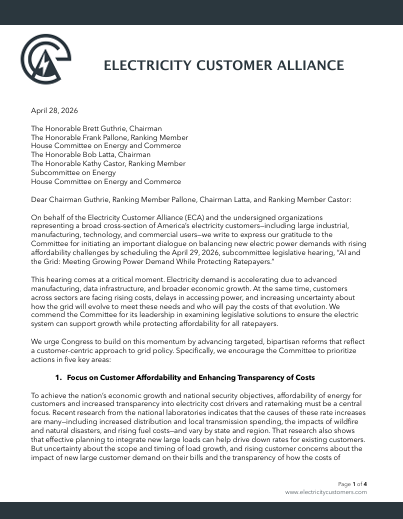
Electricity Customer Alliance Submits Letter to House Energy & Commerce Committee for Hearing on AI and the Grid
The Electricity Customer Alliance submitted a letter to the House Committee on Energy and Commerce for its Energy Subcommittee hearing "AI and the Grid: Meeting Growing Power Demand While Protecting Ratepayers."
The letter urges Congress to keep affordability and transparency front and center and outlines the following priorities:
Protect ratepayers from unfair cost shifts tied to large load growth.
Increase transparency into electricity cost drivers and ratemaking.
Accelerate transmission, permitting, and infrastructure development.
Deploy near-term solutions like grid-enhancing technologies (GETs).
Enable flexible, customer-led solutions like “bring your own power”.
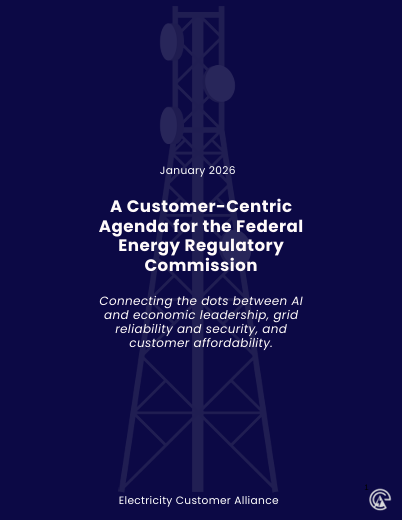
A Customer-Centric Agenda for the Federal Energy Regulatory Commission
The Electricity Customer Alliance released a new white paper, A Customer-Centric Agenda for the Federal Energy Regulatory Commission. The piece examines how rapid growth in electricity demand—driven by AI, data centers, advanced manufacturing, and broader electrification—is straining regulatory and market structures that were not designed for this pace of change. It argues that without modernization, these mismatches risk undermining grid reliability and accelerating affordability challenges for customers. Against this backdrop, the paper frames FERC as a pivotal institution in aligning grid growth with American economic competitiveness and national security priorities, while ensuring that rising demand does not translate into rising costs for households and businesses.
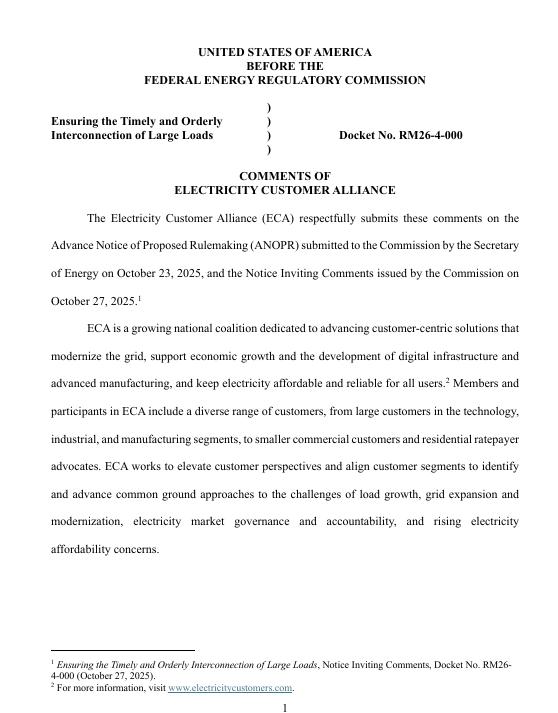
Electricity Customer Alliance Submits Comments on ANOPR on Ensuring the Timely and Orderly Interconnection of Large Loads
ECA submitted comments on the Announced Notice of Proposed Rulemaking submitted to FERC by the Secretary of Energy in October. ECA agrees that FERC action is urgently needed to address the rapid growth of large electricity loads—from AI data centers to onshored manufacturing—while protecting affordability and reliability for all customers. ECA emphasizes three priorities: enabling flexible, near-term “speed to power” options that allow large loads to fund their own growth; planning for efficient long-term integration of these loads into the grid to lower systemwide costs; and strengthening transparency, accountability, and customer representation in transmission planning, rate decisions, and market governance. Together, these steps will ensure the U.S. can meet economic and national-security imperatives without imposing undue costs on consumers.
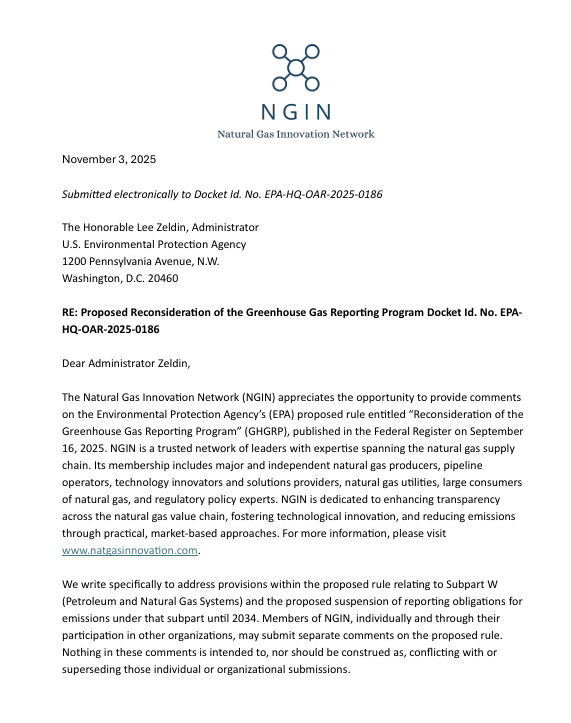
Natural Gas Innovation Network Submits Comments on EPA's Proposed Rule “Reconsideration of the Greenhouse Gas Reporting Program”
NGIN submitted comments to the Environmental Protection Agency(EPA) on its proposed rule “Reconsideration of the Greenhouse Gas Reporting Program (GHGRP)” — highlighting the need for credible, consistent, and transparent emissions data across the U.S. natural gas value chain.
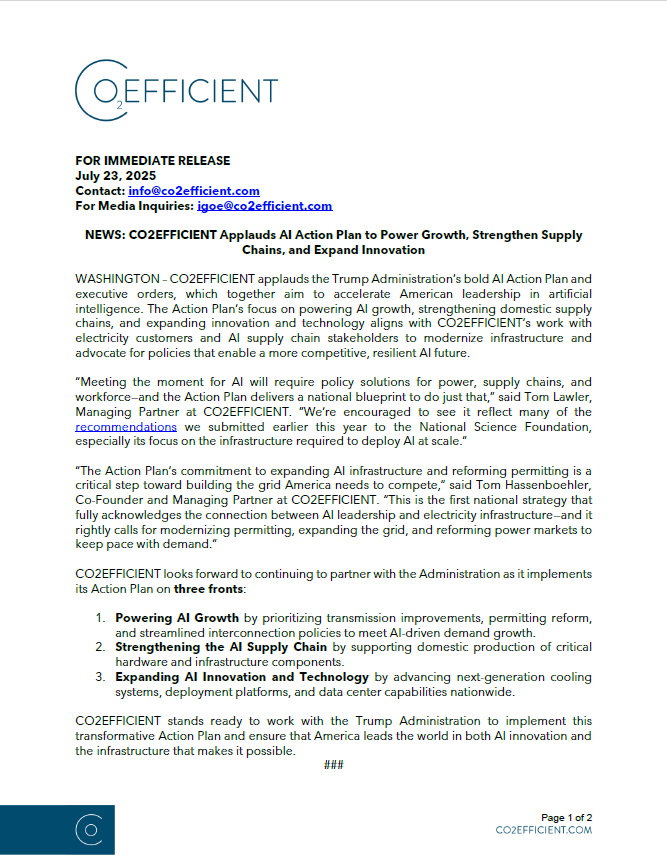
CO2EFFICIENT Applauds AI Action Plan to Power Growth, Strengthen Supply Chains, and Expand Innovation
CO2EFFICIENT released a statement applauding the Trump Administration’s bold AI Action Plan and executive orders, which together aim to accelerate American leadership in artificial intelligence. The Action Plan’s focus on powering AI growth, strengthening domestic supply chains, and expanding innovation and technology aligns with CO2EFFICIENT’s work with electricity customers and AI supply chain stakeholders to modernize infrastructure and advocate for policies that enable a more competitive, resilient AI future.

Liquid Cooling Coalition (LCC) Responds to Request for Information for a 2025 National AI R&D Strategic Plan
The LCC submitted a response to the National Science Foundation’s RFI on the 2025 National AI R&D Strategic Plan, urging federal investment in liquid cooling research to meet the growing infrastructure demands of AI. With data centers projected to consume up to 12.8% of U.S. electricity by 2028, LCC emphasizes that liquid cooling is essential to efficiently manage the high thermal loads of advanced AI systems.

AI Supply Chain Alliance (AI-SCA) Responds to Request for Information on the Development of an AI Action Plan
Responding to the National Science Foundation’s Request for Information on the Development of an AI Action Plan, the AI-SCA highlights the urgent need for grid modernization, scalable data centers, research and development, and public-private partnerships to sustain U.S. leadership in AI.

Digital Infrastructure Industries Respond To Request for Comment on Bolstering Data Center Growth, Resilience, and Security
Responding to the National Science Foundation’s Request for Information on the Development of an AI Action Plan, the AIC highlights the urgent need for grid modernization, scalable data centers, research and development, and public-private partnerships to sustain U.S. leadership in AI.

Promise and Peril: Sustainability & the Rise of Artificial Intelligence
Artificial intelligence (AI) could have profound beneficial impacts in a range of areas, including efforts to address climate change and other sustainability issues. At the same time, the growth of AI — and the infrastructure needed to support it — will create additional sustainability challenges.
This paper explores the promise of AI in advancing climate and sustainability solutions across the economy (i.e., its “handprint”), the potential peril of its environmental impacts (i.e., its “footprint”), and offers strategic policy recommendations to maximize AI’s sustainability benefits while mitigating its environmental footprint.
Let’s work together to drive impactful results.
Discover how CO2EFFICIENT can help your business thrive.
